

Words shape how we see the world, and how we see the world shapes how we act. This is one of the more reliably documented findings in psychology, and it has significant consequences in everyday life.
We know that the same event, described in two different ways, can produce two different decisions in the same person.
This is true in medicine, politics, advertising, and in the small judgments we make about our own lives. Sometimes, the easiest way to get better results is not to review our decisions but to revisit the words we have become accustomed to using.
What This Means for Your Money
Few areas of life are shaped by language more than finance.
Markets are reported on by a media industry that thrives on drama. Financial products are designed and sold by an industry that depends on you feeling either anxious or excited. And our own internal commentary is built almost entirely from words we picked up somewhere along the way.
Many of those words don’t serve us. They were coined by journalists chasing readers or by industries selling products. Some words are even relics of traditions that no longer fit how investing actually works.
These words generate feelings in us that drive financial decisions more often than facts do, and when these decisions lead to suboptimal long-term results, it’s our responsibility to challenge the words that no longer serve us.
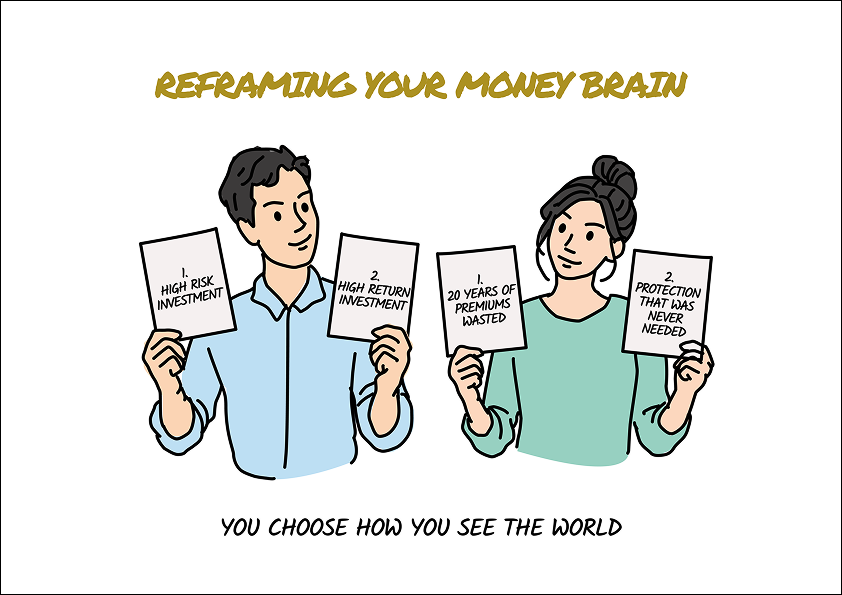
Some of the Worst Offenders
A few examples make the point clearly.
Crash. A 10%-20% decline in the market is often labelled a crash. This word suggests injury, damage, and loss. No investor wants to experience these things. But markets decline by this amount almost every year. Most of what gets reported as a crash is just a temporary decline, a valuation reset, or a reaction to an event unrelated to the economy’s long-term prospects.
High risk. For some reason, we’ve decided to label an investment by what it can do in the short term rather than what it is likely to do over the period for which it was designed. Why call a well-diversified long-term investment “high risk” when it’s more true to say that it is designed to produce high returns over the long term?
Safe in cash. Cash feels safe because it doesn’t fluctuate. But over time, inflation quietly erodes its purchasing power. The word safe does a lot of hidden damage there. Cash in an inflationary world is a slow loss, just dressed in friendlier language.
Twenty years of life insurance premiums and I’ve never claimed, what a waste. Clients sometimes feel a bit foolish for paying insurance premiums for decades without claiming. Twenty years of premiums without a claim isn’t a waste. It’s twenty years of protection your family never needed to fall back on.
The stock market. The phrase has cold, casino-like connotations, and you’re the outsider with the odds stacked against you. But the reality is that you’re buying small shares of the great companies of the world. Real businesses, selling real things, to real people.
Drawing down your pension. The words sound negative, as though the money is leaking out of something. After a lifetime of working, saving, and investing, you’re paying yourself from your life’s work. Every instalment is a return on decades of discipline.
Where That Leaves You
Awareness alone takes a lot of the power out of the wrong words.
Once you start paying attention to the language used in headlines, in product brochures, and in your own self-talk about money, you’ll see the pattern everywhere.
The second step is having someone in your corner who does this work with you. A central part of what we do for clients is translating and reframing the noise into language that reflects what’s really happening in your financial life.
We do this so that you can make decisions based on facts rather than feelings someone else has chosen for you.
Risk warnings
This article is distributed for educational purposes only and should not be considered investment advice or an offer of any security for sale. This article contains the opinions of the author but not necessarily the Firm and does not represent a recommendation of any particular security, strategy, or investment product. Reference to specific products is made only to help make educational points and does not constitute any form or recommendation or advice. Information contained herein has been obtained from sources believed to be reliable but is not guaranteed.
Past performance is not indicative of future results and no representation is made that the stated results will be replicated.